

An all-trail shoe that favors agility over bulk
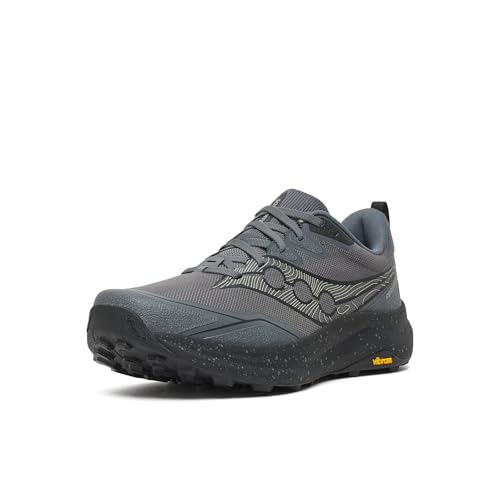
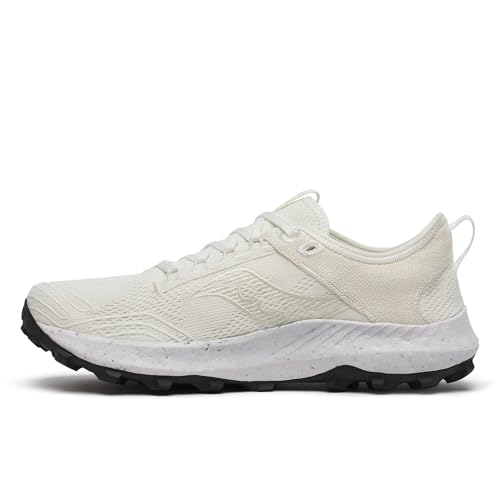
The Saucony Peregrine 14 Men's occupies a useful middle ground between light trail racers and heavily cushioned mountain shoes. It is protective enough for everyday off-road running, yet low and responsive enough to feel engaged with the trail. Saucony describes it as an all-trail specialist, and the design supports that claim with PWRRUN cushioning, a PWRRUN+ sockliner, a debris-resistant upper and a PWRTRAC outsole with versatile lugs. The Peregrine has long appealed to runners who want one shoe for short technical sessions, ordinary trail miles and moderate long runs without carrying the volume of a max-cushion platform. This review covers the exact men's listing attached to ASIN B0CMBFHHQY. Its strengths are balanced traction, a nimble ride and protection that does not dominate the experience. It is not a deep-mud specialist or an ultra-plush cruiser. Instead, it gives the runner a direct, controlled platform for varied dirt, rock and roots. That makes it a sensible option for athletes who enjoy changing pace and want a shoe that responds quickly when the trail twists.
Quick answer
The Saucony Peregrine 14 is a versatile daily trail shoe with secure PWRTRAC grip, moderate cushioning and better ground connection than high-stack alternatives. It performs well on mixed dirt, rock, roots and ordinary mud. Runners who want deep cushioning, a very broad toe box or specialized studs for prolonged soft ground may prefer a different design.
Fit and upper construction
The Peregrine 14 fits like a performance trail trainer. The heel and midfoot feel secure, while the forefoot provides practical room without becoming loose on side slopes. Debris-resistant construction and a gusseted feel around the tongue help prevent grit from entering the shoe, and reinforced areas protect the mesh from brush and minor impacts. The upper is substantial enough for everyday use but avoids the stiff, layered sensation of a hiking shoe. Lace adjustment is straightforward and allows more local control than a speed-lace system. Runners can ease tension over a sensitive instep while keeping the ankle area secure. The front shape is conventional rather than anatomically broad. Most average-width feet should find the hold familiar, while high-volume or wide feet need to verify pressure around the forefoot. Descending fit is the key test: the heel should remain planted and the toes should not contact the front. Because the shoe is responsive and relatively nimble, a sloppy fit undermines one of its main advantages. Test it with actual trail socks and allow for mild swelling on longer days.
PWRRUN cushioning and underfoot feel
Saucony uses a softer blend of PWRRUN foam to reduce impact without turning the shoe into a deep, rolling platform. A PWRRUN+ sockliner adds step-in comfort and a small layer of responsiveness close to the foot. The resulting ride feels controlled, moderately cushioned and connected. Runners can sense the shape of the trail, but sharp features are filtered enough for regular training. The platform responds well to pace changes because there is less foam to compress and recover than in a max-cushion shoe. On climbs, the forefoot flexes naturally and lets the runner engage the toes. On descents, the cushioning takes the edge off repeated impacts while the lower profile helps maintain confidence. The Peregrine 14 is not the softest option for very long ultras, especially for runners who depend on abundant foam late in an event. It is also not minimalist. Its balance suits athletes who want protection without losing the tactile information that supports quick foot placement. On hardpack, the ride feels efficient; on rocks and roots, the shoe remains composed without seeming detached from the ground.
As an Amazon Associate, we may earn from qualifying purchases.
View the mid-guide match on AmazonPWRTRAC traction across mixed terrain
The PWRTRAC outsole uses a versatile lug layout intended to grip a range of surfaces. The lugs are deep enough to enter loose soil and ordinary mud, but not so extreme that the shoe becomes awkward on packed dirt or rock. Tacky rubber helps on dry stone and damp roots, while the multi-directional edges contribute to climbing and braking. This is the kind of outsole that makes sense on routes where surface changes are frequent. A runner can leave a hardpacked trail, cross loose gravel, enter a root-filled forest and descend a dusty slope without feeling that the shoe is dramatically mismatched. Deep clay mud remains a limitation. Dedicated soft-ground shoes use taller, more widely spaced studs to penetrate and release sticky soil. Smooth pavement is also not the outsole's ideal setting, although short connectors are manageable. The Peregrine's traction feels confident without becoming the entire personality of the shoe. It supports agile movement rather than forcing a heavy, planted stride, which is why the model works well for runners who enjoy technical trails but do not want a specialized mountain shoe for every outing.
Rock protection and trail control
Protection comes from the interaction of the outsole, midsole and forefoot barrier. Sharp stones are distributed rather than allowed to press directly into one point, and the toe area provides a practical buffer against roots. The shoe remains flexible enough to contour around ordinary obstacles. That flexibility helps the runner maintain contact when stepping across irregular terrain, while the relatively low profile reduces the leverage that can make tall shoes feel uncertain on side slopes. Trail control is one of the Peregrine 14's strongest qualities. The runner receives enough feedback to adjust quickly, and the secure upper keeps those adjustments connected to the outsole. The shoe does not eliminate fatigue or poor technique, but it makes precise movement easier than a bulky platform might. Very rocky alpine routes may call for more armor, particularly for runners who land heavily. Conversely, smooth paths may not require all of the protection present here. The Peregrine sits between those extremes and is most useful on everyday technical terrain where rocks and roots are frequent but not relentlessly sharp.
Best uses, distances and terrain
The Peregrine 14 fits daily trail training, uptempo off-road sessions, hilly weekend runs and moderate long outings. It works well on forest singletrack, hardpack, gravel, rocky paths and mixed conditions with occasional mud. Runners who rotate shoes can use it as the nimble option beside a softer long-distance model. Runners who prefer one trail shoe can use its broad competence across many sessions. Distance suitability depends on cushioning preference. Efficient runners who like ground feedback may be comfortable for long hours, while athletes accustomed to deep foam may reserve it for shorter or medium-length efforts. The shoe's conventional geometry makes it approachable for runners transitioning from road shoes, though the lugged outsole and trail protection create a firmer, more textured ride. It can also serve fast hikers who value grip and flexibility. The standard model is not a waterproof membrane shoe, so wet conditions should be managed through socks, drainage and post-run drying. For deep snow, continuous bog or pavement-heavy routes, a more specialized design will perform better.
Limitations and alternatives
The Peregrine's balanced design means it avoids extremes, but some runners actively want those extremes. A HOKA Speedgoat 6 provides more cushioning and a broader sense of protection for long technical mountain days. A Salomon Speedcross 6 penetrates deep mud more aggressively. An Altra Lone Peak 9 offers a roomier toe box and level platform for runners committed to that geometry. The Peregrine 14 instead offers a lower, more traditional, agile experience. Broad-footed runners may find its standard forefoot restrictive, and cushioning-focused ultrarunners may want more foam. The tacky outsole and lugs are unnecessary for frequent road use. Runners should also resist choosing the shoe merely because it is versatile; fit remains decisive. A secure heel with uncomfortable toe pressure will not improve over a long descent. The right user appreciates a shoe that feels responsive, protected and uncomplicated rather than maximal. For that runner, the Peregrine's lack of a dramatic gimmick is a strength.
Final verdict
The Saucony Peregrine 14 Men's is a well-balanced trail trainer for runners who want grip and protection without losing agility. PWRRUN cushioning softens impact while preserving trail feel, PWRTRAC rubber handles varied surfaces, and the upper secures the foot without excessive structure. It is most successful on mixed trails where the runner changes pace and surface often. Deep mud specialists, max-cushion fans and runners needing a broad anatomical toe box have clearer alternatives. Everyone else gets a responsive all-trail shoe that can support daily training, technical practice and weekend exploration with a consistent, controlled character.
People also ask
Questions that extend this decision
Is the Saucony Peregrine 14 good for beginners on trails?
Yes, for beginners who want a conventional fit and moderate cushioning. Its secure traction and relatively low profile feel predictable, though new trail runners should still build distance gradually and practice on easier terrain first.
Can Peregrine 14 lugs handle wet roots?
PWRTRAC rubber provides useful grip on many damp roots, but wet wood remains unpredictable. Short steps, a centered landing and reduced speed are still necessary, especially on angled or polished roots.
Is the Peregrine 14 cushioned enough for long runs?
It is cushioned enough for many runners' long outings, particularly those who prefer ground connection. Runners accustomed to maximal foam may find it better for short and medium distances than all-day efforts.
Does the Saucony Peregrine 14 need a break-in period?
The shoe should feel secure and runnable from the start, although a few shorter outings help confirm lace tension and sock choice. Persistent pinching, numbness or heel slip is a fit issue rather than normal break-in.
How should the Peregrine 14 be cleaned after muddy runs?
Let mud dry, brush off loose soil, remove the insole and rinse stubborn areas gently with cool water. Air-dry away from direct heat, which can damage adhesives, upper materials and cushioning foam.
Final verdict
Choose the tradeoff you understand.
The Saucony Peregrine 14 Men's occupies a useful middle ground between light trail racers and heavily cushioned mountain shoes. It is protective enough for everyday off-road running, yet low and responsive enough to feel engaged with the trail. Saucony describes it as an all-trail specialist, and the design supports that claim with PWRRUN cushioning, a PWRRUN+ sockliner, a debris-resistant upper and a PWRTRAC outsole with versatile lugs. The Peregrine has long appealed to runners who want one shoe for short technical sessions, ordinary trail miles and moderate long runs without carrying the volume of a max-cushion platform. This review covers the exact men's listing attached to ASIN B0CMBFHHQY. Its strengths are balanced traction, a nimble ride and protection that does not dominate the experience. It is not a deep-mud specialist or an ultra-plush cruiser. Instead, it gives the runner a direct, controlled platform for varied dirt, rock and roots. That makes it a sensible option for athletes who enjoy changing pace and want a shoe that responds quickly when the trail twists. Fit comes first, the repeated session demand comes second, and the exact current product identity comes third. Use Amazon to verify sizes and options without relying on stale price or stock claims.
As an Amazon Associate, we may earn from qualifying purchases.
Check current options on Amazon