

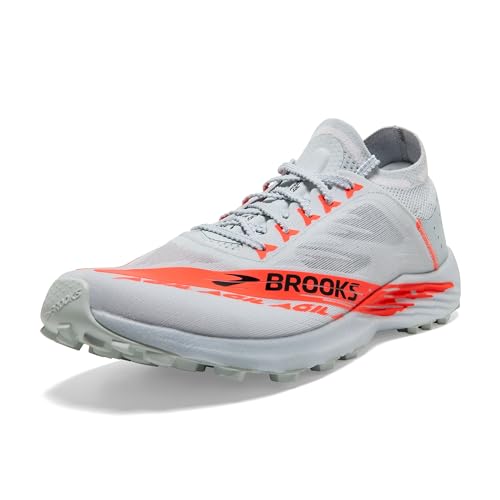

Best lightweight family option: adidas Terrex Agravic SL
The Agravic SL is the logical first comparison for runners attracted to the adidas trail line but not seeking the Speed Ultra 2's race-focused system. The supplied Amazon catalog includes an exact Agravic SL listing, and adidas positions SL as a lighter trail-running option. Its purpose is everyday speed and versatility rather than reproducing a carbon road super shoe off-road.
Verify the exact product specifications before publication or purchase, because the Agravic family now contains standard, Speed, Speed Ultra, SL, and GORE-TEX branches. A vague “Agravic” button can lead to the wrong platform. Choose SL when reduced bulk and a familiar trainer feel matter, then confirm that its outsole suits the route rather than selecting by weight alone.
Best nimble daily trainer: Saucony Peregrine 14
Peregrine 14 offers a balanced non-plated route to faster trail days. It is established in the supplied catalog as a nimble all-trail daily trainer, which makes it more useful than a pure race shoe for runners who want one pair for workouts and ordinary miles. The appeal lies in agility, trail protection, and a broad terrain range rather than a mechanical plate sensation.
Use it for mixed singletrack, rolling dirt, and runs where pace changes frequently. Check the exact edition and fit; newer or waterproof variants can differ. A nimble shoe that allows heel movement or toe contact is not fast in practice, so security outranks a small weight difference.
Best for rocky speed: La Sportiva Bushido III
Bushido III shows why non-plated does not mean unprotected. Its forefoot uses a compressed EVA rock guard rather than a carbon propulsion plate, and the platform is reinforced for off-camber control. On rocky races, short mountain efforts, and technical descents, accurate placement can matter more than bounce.
The trade is firmness. Bushido will not suit every runner over long hardpack, and its performance fit requires deliberate sizing. The standard and Wide versions should be evaluated separately. Choose it when the course repeatedly rewards lateral security and rock protection; choose a smoother trainer when the route is fast because it is easy rather than technical.
Best road-to-trail speed option: Nike Pegasus Trail 5
Pegasus Trail 5 remains available in the supplied Amazon catalog even as Nike's current direct model advances to ACG Pegasus Trail. The fifth edition suits faster runs that combine pavement, gravel, and moderate dirt because its family prioritizes smooth cushioning and a versatile outsole over deep lugs. That makes it commercially relevant, but it must be labeled as Trail 5 rather than silently merged with the current ACG version.
Choose it for tempo-style mixed routes and steady progression runs. Avoid assuming road familiarity equals technical racing control. On deep mud or continuous rock, another candidate offers more specific outsole or platform architecture.
As an Amazon Associate, we may earn from qualifying purchases.
View the mid-guide match on AmazonWhat makes a trail shoe feel fast without a plate
Low perceived weight helps, but fast feel also comes from fit that eliminates correction, foam that rebounds predictably, forefoot geometry that transitions cleanly, and traction that lets the runner apply force. Flexibility can help a shoe conform to uneven ground, while too much flexibility can increase fatigue on sharp terrain. There is no single recipe.
Course type changes the ranking. Smooth races reward transition and cushion. Rocky races reward precision and protection. Muddy races reward penetration and release. A plate can be useful in some designs, but excluding it does not relegate a runner to slow equipment. It simply shifts attention toward the complete system.
Why some runners deliberately avoid plates
A runner may prefer natural forefoot flex, easier adaptation, lower price, or a shoe that works for training as well as events. Technical ground can also interrupt the consistent loading pattern that makes a rigid propulsion system attractive on smooth surfaces. These are preference and use-case reasons, not evidence that plates are harmful.
Conversely, choosing non-plated does not remove adaptation needs. Changes in drop, stack, foam, or rocker can still stress unfamiliar tissues. Introduce any new race shoe through short training runs and verify that it remains comfortable after descents and uneven sections.
Race-day fit and outsole test
Use the socks planned for the event and run at least one representative workout before racing. Include climbing, descending, and the wettest or loosest surface available. Check heel movement when pace rises, toe contact on descent, and whether the outsole packs with soil. A clean treadmill test cannot answer those questions.
Do not race an untested marketplace variation simply because the model name is familiar. Waterproof uppers, width changes, and new generations can alter heat, volume, and flexibility. Confirm that the ASIN matches the edition described in the shortlist.
Choosing among the four
Pick Agravic SL for light everyday speed, Peregrine 14 for versatile singletrack, Bushido III for rocky technical control, and Pegasus Trail 5 for mixed road-and-dirt pace. If the event is muddy, this list may not contain the best tool; compare a Speedcross or another soft-ground design instead. If the event is an ultra on smooth trail, a more cushioned model may preserve comfort better.
The fastest purchase decision is the one grounded in the course. Review elevation, substrate, likely weather, road percentage, and longest descent. Then select the shoe whose compromise occurs least often.
Training use matters after race day
A non-plated shoe often earns its value by returning to ordinary training after an event. Agravic SL and Peregrine can cover workouts and daily miles; Pegasus Trail 5 can handle mixed-surface commuting runs; Bushido can remain the technical-session tool. That broader use reduces the pressure to save a shoe for one start line.
Still, race use should not excuse worn traction. Inspect lugs, upper hold, and ride changes before important events, especially after abrasive rock or pavement. A shoe that feels quick in a short workout may become tiring over the target distance. Schedule a representative long or technical session early enough to choose another pair if the platform, fit, or outsole proves mismatched.
People also ask
Questions that extend this decision
Are non-plated trail shoes slower?
Not inherently. Course, runner, fit, traction, foam, and technical skill influence pace. A plate is one design element and may be less decisive when terrain repeatedly disrupts smooth loading.
Does a rock guard count as a propulsion plate?
No. A rock guard or rock plate is primarily intended to spread pressure from sharp objects. Materials and stiffness vary, but its role should not be confused with a carbon system designed around propulsion.
Which pick works best on pavement?
Pegasus Trail 5 is the strongest road-to-trail candidate. Its smoother mixed-surface purpose is more compatible with asphalt than Bushido's technical platform or a deep soft-ground outsole.
Which non-plated shoe suits rocky races?
Bushido III is the clearest rocky-course choice in this list because of its rock guard, side-wrapping outsole, and performance fit. Verify that its firmer ride suits the race distance.
Should I buy the lightest available size?
No. Published weight is based on a sample size and changes across sizes. Fit, traction, and control produce more practical value than choosing a shoe that is lighter but mismatched.
Final verdict
Choose the tradeoff you understand.
Runners can get a quick trail feel without a carbon propulsion plate by prioritizing low bulk, secure fit, responsive foam, useful flexibility, and an outsole matched to the course. Strong candidates include the adidas Terrex Agravic SL for lightweight trail training, Saucony Peregrine 14 for nimble versatility, La Sportiva Bushido III for technical precision, and Nike Pegasus Trail 5 for faster mixed road-to-trail runs. Confirm the exact edition because plated and non-plated relatives may share family names. Fit comes first, the repeated session demand comes second, and the exact current product identity comes third. Use Amazon to verify sizes and options without relying on stale price or stock claims.
As an Amazon Associate, we may earn from qualifying purchases.
Check current options on Amazon