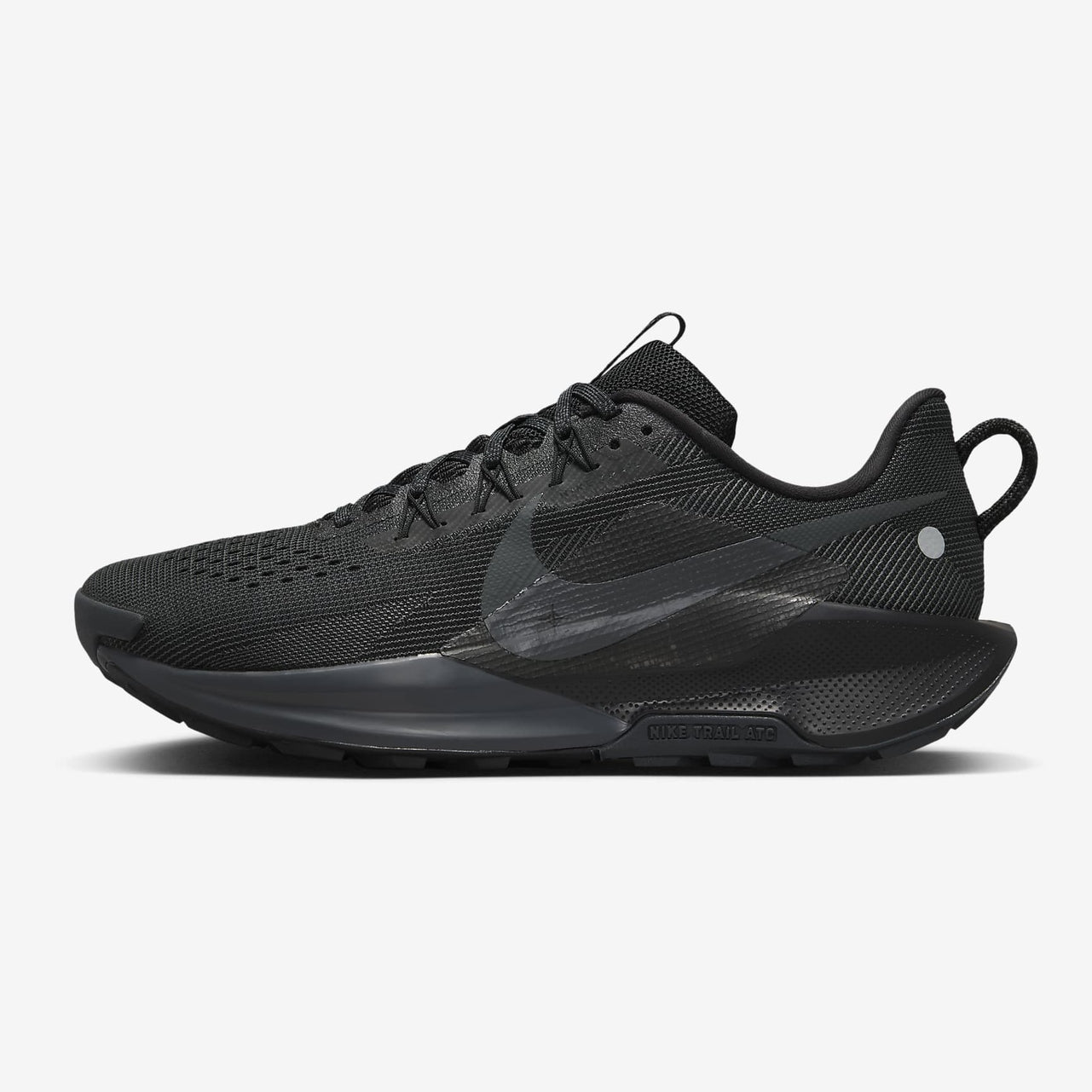



What changed in the current Pegasus Trail
Nike now presents the shoe as the ACG Pegasus Trail rather than simply adding another number to every storefront title. The current US product page describes more ReactX foam than before, a higher stack, a revised toe box, and a new generation of All Terrain Compound rubber. That creates an important buying wrinkle: Amazon may still show Pegasus Trail 5 listings beside the newer ACG edition. They are related, but they should not be treated as the same product without checking the title, style code, photographs, and specifications.
The family purpose remains recognizable. This is the Pegasus interpretation of a trail shoe: familiar running-shoe cushioning, an outsole built for mixed surfaces, and less specialization than a soft-ground or mountain model. The new edition appears to lean further into comfort and toe room. That makes it more interesting for steady mileage and broad trails, while preserving the central question that has always defined the Peg Trail: how much technical capability do you need beyond a smooth road-to-trail ride?
Ride: cushioned and familiar rather than sharply technical
The ReactX midsole is the heart of the experience. Nike describes it as responsive and stable, and the increased amount of foam suggests a more protective daily ride than a low-stack trail racer. An 8 mm listed drop keeps the geometry within a conventional moderate band. Runners coming from mainstream road trainers may find that easier to understand than a sudden shift to zero drop or a very firm mountain shoe.
Cushion does not automatically mean vague, but the Pegasus Trail is not designed around maximum ground feel. On rolling dirt and gravel, the smoothness is likely to be the attraction. On repeated rock steps or narrow off-camber lines, platform height, upper hold, and individual fit become more important. A buyer who values minute surface feedback should compare a lower technical model. Someone who wants one shoe to leave the front door, cover a road approach, and settle into mellow singletrack has a clearer reason to choose the Nike.
Outsole: versatility before mud specialization
Nike calls out improved wet-terrain traction from its current All Terrain Compound. That is useful evidence about the design target, not a promise that the shoe cannot slip. Surface film, algae, polished rock, lug wear, and foot placement still affect grip. The outsole is shaped for varied ground rather than the widely spaced, deep teeth of a dedicated mud shoe.
That compromise is sensible on road-to-trail routes. Extremely aggressive lugs can feel awkward and wear quickly on pavement; shallow road-like tread can struggle when soil turns loose. The Pegasus Trail aims between those extremes. Expect the strongest case on dry or damp hardpack, gravel, park trails, and mixed outings with asphalt connectors. For steep mud, wet grass, or deep loose soil, compare a soft-ground shoe with more pronounced lug geometry. For jagged rock all day, consider whether a model with clearer underfoot protection and a more locked-in mountain fit better matches the route.
Fit: the wider forefoot is the headline
Nike specifically says it added room in the toe box and forefoot. That matters because earlier Pegasus Trail shoppers sometimes approached the line as a standard athletic fit rather than a truly roomy trail platform. The current design may suit runners who want toe movement without moving immediately to a labeled wide size. It still should not be called a wide shoe by default. Shape, circumference, and available width are different things.
The heel and midfoot must hold securely when the trail tilts. Extra forefoot room is helpful only if the foot does not slide forward or laterally. Try the exact edition with trail socks, then use a short descent or inclined fitting surface if one is available. Check that toes are not touching the front, the heel is not lifting, and lace pressure remains tolerable. Runners who routinely buy wide sizes should verify a labeled width rather than relying on the phrase wider forefoot.
As an Amazon Associate, we may earn from qualifying purchases.
View the mid-guide match on AmazonBest terrain and distance
This shoe makes the most sense for smooth-to-moderate terrain: crushed gravel, rail trails, forest roads, maintained singletrack, and urban routes that include a trail segment. The cushioning also supports daily training and longer easy outings for runners who like a substantial buffer. Nike explicitly positions it for trail running, but its road-derived character remains part of the appeal.
Technical terrain is not a binary category. The Pegasus Trail can encounter rocks and roots, yet a runner moving cautiously through occasional features has different needs from someone racing prolonged talus and steep traverses. If most of the route is predictable with brief rough sections, the Nike may remain appropriate. If the entire route demands precise foot placement, a lower or more structured option such as the Bushido III deserves attention. Deep winter mud is another case where a specialist outsole can be more coherent.
Who should skip it
Skip the Pegasus Trail if your first requirement is aggressive mud traction, a firm rock-focused platform, or minimal separation from the ground. It is also a questionable choice when an exact labeled width is essential and the specific listing does not provide one. The roomy redesign may improve comfort, but it cannot substitute for verified sizing.
Runners expecting a trail version of a race shoe should look elsewhere. The current men's listing is approximately 305 grams in Nike's sample size, which reinforces the daily-trainer purpose rather than a stripped competition role. Weight varies by size and edition, so compare like with like. Finally, buyers shopping a waterproof version need to identify the GORE-TEX edition explicitly. The standard engineered-mesh shoe and the wet-weather model have different uppers and should not share one fit or climate assumption.
How it fits into a rotation
As a single trail shoe, the Pegasus works best when most miles are nontechnical and some begin on pavement. In a two-pair rotation, it can handle easy and mixed-surface days while a more specialized partner covers mud, sharp rock, or racing. That division prevents a buyer from asking the Nike to be both a pleasant road connector and a deep-lug mountain tool.
The shoe can also complement a road trainer for runners who want more outsole coverage and upper security on dirt without relearning a radically different geometry. The listed 8 mm drop may make that pairing straightforward when the road shoe occupies a similar band. Compare complete rides rather than matching one number: stack, rocker, foam softness, and forefoot flexibility can make equal-drop shoes feel unrelated.
Buying the right Pegasus Trail listing
Start with the exact product name. The current Nike page says ACG Pegasus Trail, while marketplace inventory may include Pegasus Trail 5 and GORE-TEX variants. Confirm the title, men's or women's sizing, standard or waterproof upper, color-specific style code, and return terms on the retailer page. Do not assume a lower price means the newest edition or that a product image proves the membrane version.
For the current ACG shoe, verify the 8 mm specification and wider forefoot language against Nike if a marketplace listing is sparse. If choosing the Trail 5 instead, judge it as that edition rather than transferring every statement from this review. The Amazon target attached below is explicitly the Pegasus Trail 5 and is labeled as a related prior-edition option, not as the current ACG product.
People also ask
Questions that extend this decision
Is the Nike ACG Pegasus Trail the same as the Pegasus Trail 5?
No. They belong to the same family, but Nike's current ACG listing describes a revised edition with more ReactX foam and a redesigned forefoot. Check the exact product title and style code before applying this review to a Trail 5 listing.
Can the Pegasus Trail handle pavement?
Mixed road-and-trail use is one of its clearest roles. Its ride and outsole are more road-friendly than those of a deep-lug mud specialist, though pavement wear will still vary with surface, runner, and mileage.
Is the current Pegasus Trail a wide shoe?
Nike describes a wider forefoot and toe box, but that does not automatically equal a labeled wide size. Runners who need additional width should verify the specific width option and try the exact edition.
Does the standard ACG Pegasus Trail keep water out?
The standard model uses engineered mesh and should not be presented as waterproof. Nike sells separate GORE-TEX versions in the family. Identify the upper technology in the exact listing.
What is the main alternative to this shoe?
For more technical control, consider a Bushido-style mountain shoe; for deeper mud, look toward a Speedcross-type outsole; for plush long-distance trail comfort with width choices, compare the New Balance Hierro v9.
Final verdict
Choose the tradeoff you understand.
The current Nike ACG Pegasus Trail is best understood as a cushioned door-to-trail shoe for runners who mix pavement, gravel, park paths, and moderately technical singletrack. Nike lists an 8 mm drop, ReactX foam, engineered mesh, a redesigned wider forefoot, and its current All Terrain Compound outsole. It is a less obvious choice for deep mud or runners who want a low, highly precise platform. Fit comes first, the repeated session demand comes second, and the exact current product identity comes third. Use Amazon to verify sizes and options without relying on stale price or stock claims.
As an Amazon Associate, we may earn from qualifying purchases.
Check current options on Amazon